MikhailEditor

MikhailEditor
Europe is changing. Today companies choose IT services not only by cost and reliability. A new item has appeared on the priority list: how “green” the service is. The main question is: “What is the carbon footprint of this service?” This is no longer just hype or a nod to fashion.
Since 2024, things have become much more serious. Before, nobody cared where servers were located or how “green” they were. That question usually concerned only IT teams. But now everything has changed — and the reason is a new EU directive, CSRD. It forces large companies to openly report how their activities affect the climate. As a result, the server question has moved far beyond the IT department and now concerns everyone — from executives to marketers. It has become a key issue for the entire business.
No wonder everyone is now looking at data centers that have certificates like ISO 50001 or have joined the Climate Neutral Data Centre Pact. Today it’s also a question of how ready your business is for the new European reality.
Do you think two VPS instances with the same specs — 4 cores, 8 GB of RAM — are absolutely identical? In reality, they’re not. Behind every virtual server there is a real data center, and its efficiency determines how much energy your server will consume.
This is where geography helps. Imagine: in the North, in countries like Finland or Sweden, data centers don’t spend huge money on air conditioning. Instead, they use what they have in abundance — cold. Servers are cooled with freezing outdoor air or icy lake water. This approach is called free cooling. Thanks to it, cooling costs drop by multiples. And even cooler: excess heat from servers doesn’t go to waste — it’s used to heat homes or greenhouses. Now let’s look at what happens in Central Europe — Germany, Poland, and the Czech Republic.
The climate there is milder and not always cold, so free cooling works only for a limited part of the year. Industrial air conditioners and chillers carry the lion’s share of the load. As a result, up to 40% of a data center’s total electricity consumption can go to cooling. That means two VPSs with the “same parameters” can have very different carbon footprints in practice — simply because of where the racks are physically located.
Hardware choice matters just as much. When people talked about servers, they immediately thought of Intel and AMD processors.
Everything changed when ARM servers like Ampere Altra or AWS Graviton entered the scene. They completely changed the game, proving you can deliver high performance while consuming far less energy. These processors were designed with energy efficiency in mind from day one, so for certain workloads they show an impressive “performance per watt” ratio.
For providers, this is a direct benefit: lower electricity and cooling costs. And for you as a customer, it means your virtual servers consume much less energy than before.
Sometimes the difference is tens of percent! If the workload isn’t heavy compute (for example, a database or a small web service), an ARM instance can be both cheaper and greener.
And here’s the main paradox: on a provider’s website we only see numbers — “cores, gigabytes, traffic.” But in reality, behind them lies a huge difference in carbon footprint. One VPS may sit in a “green” hydro-powered data center with ARM servers and free cooling. Another may be in a standard data center powered by a coal plant, where air conditioners run nonstop.
So for the user these two servers may look identical, but their real “environmental price” can differ by multiples. That’s why today it’s no longer enough for a business to simply compare plans.
It’s far more important to ask providers uncomfortable questions:
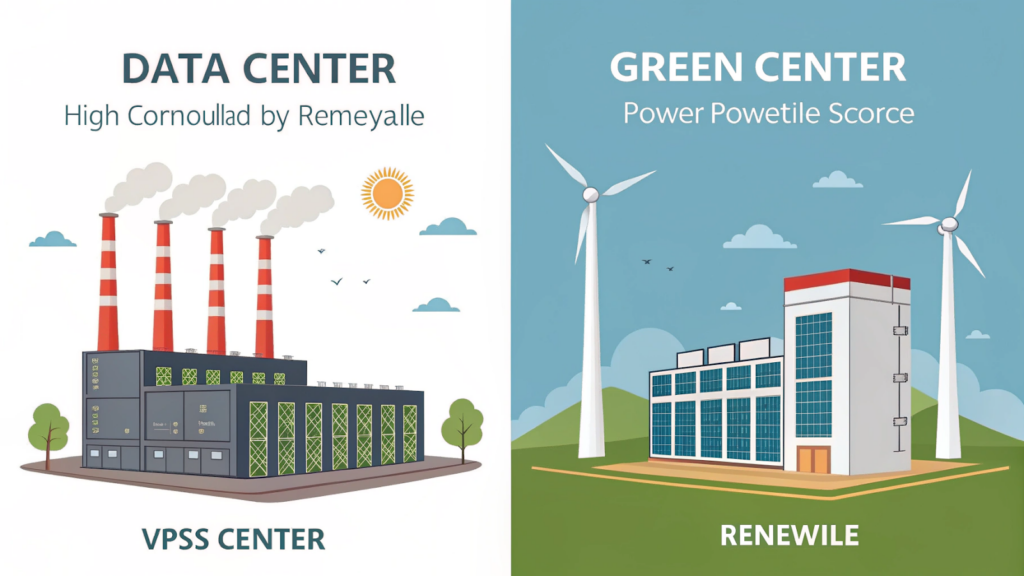
Take Hetzner, for example. They have data centers in Germany and Finland, and their main focus is energy. Hetzner’s Finnish data centers run mostly on hydropower. In practice, that means they’re powered by rivers and lakes, which makes them close to carbon-neutral.
Today, the largest European hosting providers don’t just talk about sustainability — they act. They follow the pan-European Climate Neutral Data Centre Pact, which commits participants to become climate-neutral by 2025. That means a full switch to renewable sources and maximum energy efficiency. Here’s how some of them are approaching this goal.
This company is obsessed with efficiency. They track PUE — roughly speaking, how much energy goes to the servers themselves versus “waste” like cooling. The closer PUE is to the ideal value of 1, the better. OVHcloud maintains one of the best figures on the market, which independent experts confirm.




Time4VPS doesn’t just talk about sustainability. They actually use local renewable sources — wind and solar. For customers this is a strong argument: you can confidently state in your reports that your hosting runs on “green” electricity and cares for the environment.
What unites them is a shared goal that goes beyond business. They have joined the European Climate Neutral Data Centre Pact. Its main goal is to make all data centers climate-neutral by the year 2030.
When people talk about “green” data centers, three or four cherished abbreviations usually come up. On a provider’s website they look convincing, but for non-specialists it’s hard to tell what’s behind them. Which indicators are truly useful for choosing a VPS, and which are more like marketing decoration? Let’s break it down.
Let’s talk about PUE. In essence, it’s a simple metric that shows how efficiently each watt of energy is used. Put simply, it’s the ratio of how much electricity goes to the servers themselves versus auxiliary needs: cooling, lighting, and so on. The ideal value is 1.0 — when all the energy reaches the CPUs and memory instead of “melting” in air conditioners. In practice, in Europe PUE is usually around 1.1–1.3.
But there’s a trick not everyone mentions. Be careful: sometimes providers play games. They may show impressive numbers measured only at one, most efficient site, or average data over the cold season. So if you see numbers that look too perfect, don’t hesitate to ask how real they are.
That’s why businesses should clarify what exactly was measured: an annual average across the whole data-center network, or data from a single “showcase” facility. Otherwise you risk comparing apples to oranges.
Think of PUE as how efficiently you use electricity, and CUE as where that electricity comes from. It’s a newer — but much more honest — metric. For example, two data centers can both have PUE = 1.2. But if the first runs on hydropower and the second on coal generation, their carbon footprints will differ by tens of times. That’s where CUE comes in: it measures the amount of CO₂ emissions per kilowatt-hour consumed in the data center.
Another trend is the ability to obtain a detailed “carbon report” from your host. It shows how much CO₂ is attributable to your specific VPS or project. Carbon reporting used to be the domain of giants, but now it’s becoming available to smaller companies too. Large providers like Hetzner and OVHcloud are already testing services where any customer can get a detailed report on the emissions generated by their servers. It’s very convenient: you simply attach the ready-made PDF to your ESG report and don’t waste time on complex calculations.
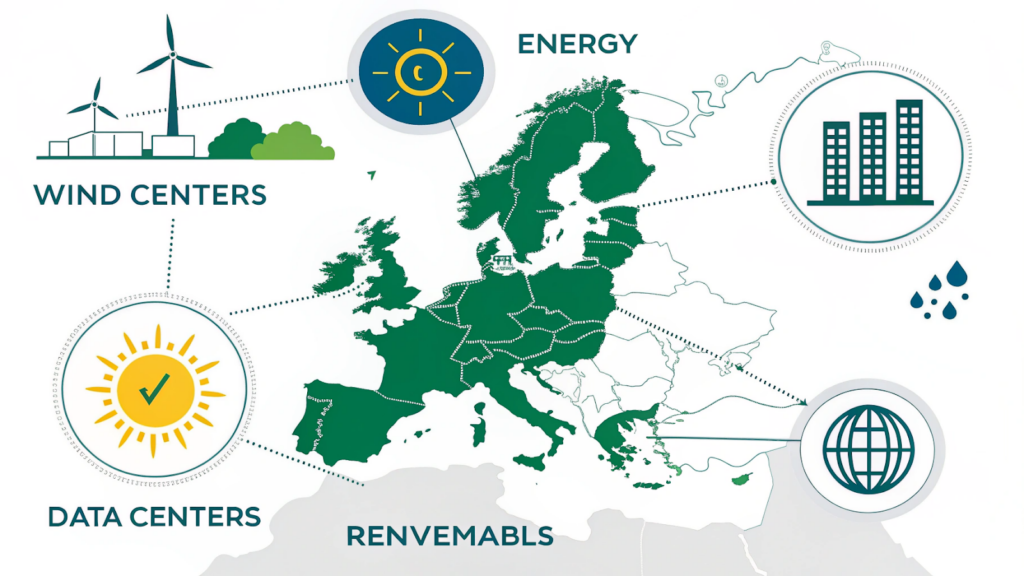
To be clear: Scope 3 is the indirect emissions produced by your contractors and suppliers. And honestly, it’s the hardest part of reporting for small and mid-size businesses. Imagine: you need data from logistics companies, office contractors, and of course your IT providers. The good news is that you can include your VPS there with minimal effort. Just request a carbon report from the provider — or at least ask for CUE indicators. As a result, you can honestly show investors: yes, we have server infrastructure, and we know its environmental footprint.
One of the simplest free tools is Scaphandre. Think of it as a “smart” assistant for your server. You install a special program and it immediately starts tracking how much energy your CPU, memory, and applications consume. It carefully collects this data and exports it to familiar tools like Prometheus and Grafana, where you can view clear charts. As a result, even a small team can see which server is the most power-hungry and which is the most economical.
If your infrastructure is built on Kubernetes, there’s a great tool called Kepler. Want to know where energy is really going in your cluster? It shows everything — from total consumption down to individual pods and microservices. Don’t be surprised if one “invisible” service suddenly turns out to “eat” half of all resources! But no worries: you’ll get an alert right away so you can spot the anomaly in time and shift the load to more efficient nodes.
Scaphandre and Kepler integrate nicely with the popular Prometheus + Grafana stack. The result is a full dashboard: colorful charts, historical trends, alerts on increased consumption. This not only helps with ESG reporting — it also genuinely saves money: you see where resources are idle and where you can optimize them.
There’s another simple but very effective trick: automatically shutting down VPS instances that aren’t being used. For example, dev or staging environments often sit idle at night and on weekends. With Terraform + Ansible, you can set up scenarios that turn these instances off and back on on a schedule. This way you reduce the hosting bill and cut Scope 3 emissions without touching the production service.
Today, a “green” VPS in Europe is more like a nice bonus and a competitive advantage. But in the coming years it will become the norm. And the driving force will be not only the market and conscious customers, but regulators as well.

Right now, large companies must report ESG metrics under the CSRD directive. But from 2026 similar requirements will affect hosting providers as well. That means data centers will be obliged to provide customers with detailed reports on CO₂ emissions and the structure of energy consumption. For business this is a huge plus: you no longer need to gather data manually and calculate emissions “blind.” Everything will be transparent and available. It’s enough to get the figures from your provider and include them in your ESG report. Imagine how much easier reporting will become for SMEs and startups that previously lacked resources for complex calculations.
Forget the “green agenda” as something distant. In Europe it’s no longer just recommendations — it’s strict rules of the game. Want to secure funding? Then you’ll have to prove you take sustainability seriously.
Initiatives like the EU Green Deal and the taxonomy of sustainable investments are not just empty words. Investors will literally scrutinize how much energy your IT infrastructure consumes. And if you don’t pay attention to it, be ready for consequences: higher loan rates and a loss of trust. Don’t miss the moment to show that your business is not only profitable, but also responsible.
A logical trend is separate “green” VPS plans with a guarantee of 100% renewable power. Imagine a provider offering two instances with the same configuration. One runs on the standard grid, the other on solar or hydropower, with a transparent emissions report. Customers may pay a little extra but gain confidence that their infrastructure is fully “clean.” In essence, it’s like switching to an electric car: more expensive, but greener and with the prospect of reducing future risks.
The future of a “green” VPS is not only plans and reports, but full automation. Imagine: you can control your servers with one click. Use sensors and special software to automatically shut down equipment that is idle. In a couple of years this will become normal for any company. You’ll be able to track, in real time, how much energy your virtual machines consume — and save money on it without any hassle.
Today, choosing a VPS is no longer purely a technical question. When selecting hosting, what matters is not only price, performance, and service stability (uptime). Standard business requirements now also include something new and very significant — sustainability. In Europe everyone knows this: it’s no longer a “nice add-on” to your image, but real proof that the business is thinking about the future.
Integrating provider selection into your ESG strategy is a very practical and forward-looking step.
Forecast: by 2030, “green” hosting will no longer be a trend, but the norm in Europe. Those who don’t prepare in time risk falling behind. Those who get on board early will be one step ahead. Because sustainability in IT is not about nice slogans — it’s a competitive advantage in a world where every kilowatt-hour and every gram of CO₂ matters.