The power of premium servers
We use best-in-class Intel Xeon Gold and Platinum series processors and ultra-fast All-Flash drives. Guaranteed data access – at any millisecond.
A customized high-level secure physical infrastructure built on a Tier III data center foundation. Our 40 GB of network bandwidth ensures high availability and connection stability. Scalability and customization are ready for any task.

We use best-in-class Intel Xeon Gold and Platinum series processors and ultra-fast All-Flash drives. Guaranteed data access – at any millisecond.
Our data centers in Frankfurt provide comprehensive protection, reliability, and availability of critical and sensitive data. You can focus on your business with peace of mind, knowing your data is in safe hands.
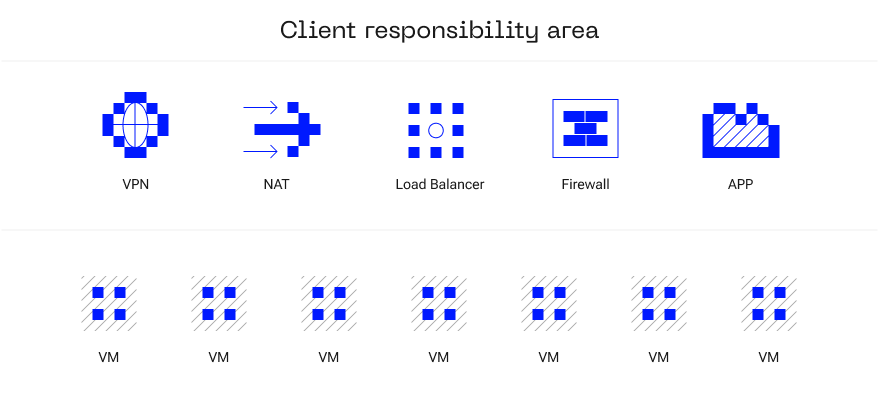
Individualized computing resources and infrastructure with isolation from other clients. Other people's mistakes won't be your problem. Customize your own rules for accepting and sending traffic or cut off unwanted traffic, enhancing security.
Total control at your fingertips: virtualize servers, manage databases, backups and other tools. Use the API and CLI or Terraform to quickly create and control your instances.
Ready-made physical infrastructure in professional data centers reduces maintenance and support costs. Scale quickly to the number of servers you need. Reduced risk of downtime.
2 hosts
Intel Xeon E5-1650 v4, core
3.6 Hz, rate
6/12, cores/thread
16 Gb, RAM
2000 Gb, storage
4x10 Gbit/s, network
2 hosts
Intel Xeon E5-1650 v4, core
3.6 Hz, rate
6/12, cores/thread
16 Gb, RAM
2000 Gb, storage
4x10 Gbit/s, network
2 hosts
Intel Xeon E5-1650 v4, core
3.6 Hz, rate
6/12, cores/thread
16 Gb, RAM
2000 Gb, storage
4x10 Gbit/s, network
2 hosts
Intel Xeon E5-1650 v4, core
3.6 Hz, rate
6/12, cores/thread
16 Gb, RAM
2000 Gb, storage
4x10 Gbit/s, network
2 hosts
Intel Xeon E5-1650 v4, core
3.6 Hz, rate
6/12, cores/thread
16 Gb, RAM
2000 Gb, storage
4x10 Gbit/s, network
We will prepare an individual project for your business. Leave a request and we will contact you as soon as possible
By renting a private cloud from Peerobyte, you relieve yourself of the pressure of managing physical hardware. We are responsible for the servers, networks, administration and monitoring of the virtualization infrastructure.
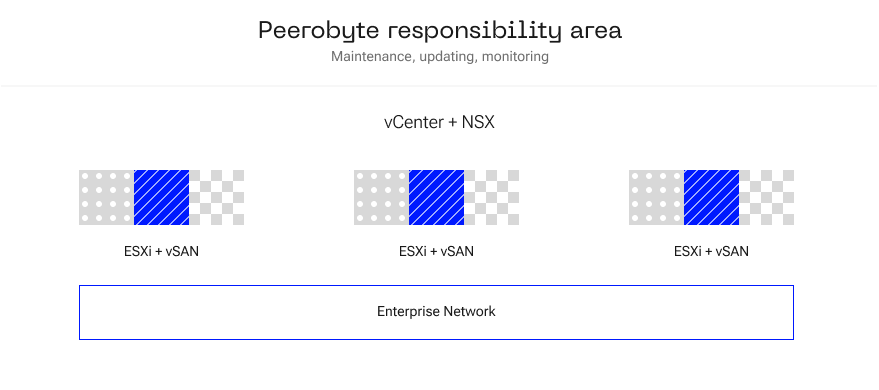
The real-time distributed resource scheduler balances the load between cluster nodes. Your applications in the cloud will work efficiently under any load. With no exceptions.
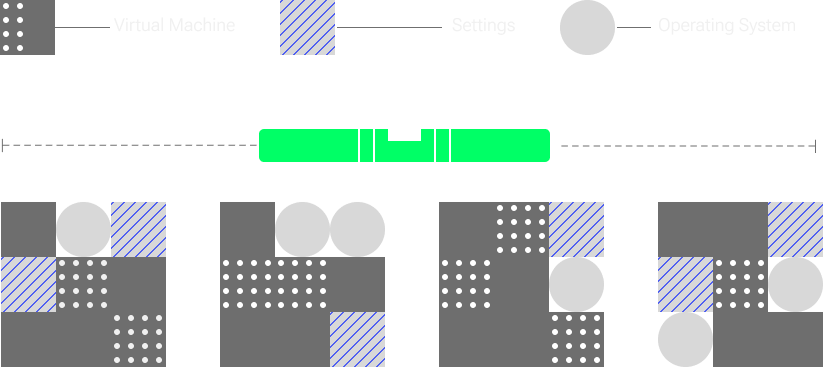
HA ensures the continuity of virtual machines in the Peerobyte even if host errors, hardware failures or network problems occur. Maintenance mode is activated automatically, and virtual machines migrate to other nodes in the cluster - imperceptibly to users.
Create a robust and secure architecture independent of other clients. Customize and scale your resources for specific tasks. Our high 40 GB bandwidth ensures high reliability and network stability at all times.
Can't find an answer to your question? Ask us and we'll tall you!
A private cloud is a cloud infrastructure where resources are available only to a specific organization. Such a cloud is deployed on your own or leased infrastructure.
A private cloud architecture is the consolidation of computing resources in data centers into a single pool under the control of a specialized software suite. By virtualizing the hardware infrastructure (software-defined networks, virtual machines), the efficiency and reliability of the infrastructure is increased.
A private cloud can use the global network for its own needs and can have several data centers in different regions merged into a single system.
A managed private cloud is a cloud environment in which one company uses and owns the resources, while the management and maintenance of the infrastructure is outsourced to a third party. For example, your organization's IT infrastructure may be purchased and maintained by a third party in its data center.
A managed private cloud allows you to shift many of the cloud management responsibilities to a colocation partner who has greater expertise and efficiency in maintaining the IT infrastructure. The private cloud service partner can also provide additional services, such as backup and business continuity solutions.
The benefits of using a private cloud are:
A private cloud's level of security is higher because the company that owns a private cloud can independently enforce the security policies it needs and organize its infrastructure to minimize or block traffic that leaves its infrastructure.
Proprietary hardware ensures that loads caused by third-party activities are not weighed down and are hard to predict.
Using a private cloud in the long run and with sufficient volume can be more profitable than using a public cloud due to the elimination of the profits that the public cloud provider puts in.
Projected costs
The cost of a public cloud can be unpredictable as it is shaped by the cloud provider and the market, while the cost of a private cloud is more predictable in the long run.
You can build your own cloud infrastructure to meet any requirements and make the necessary infrastructure changes without concern for other users. The geographic location of your own infrastructure is not limited, where public infrastructure may simply not be available in the region.
Private clouds are limited to specific physical machines, the security of which is easier to enforce than the security of a public cloud provider. Private clouds are usually protected by a firewall and are accessible over private secure network connections, not the public Internet. Control over a private cloud can be enforced according to your own security protocols, while in a public cloud you will have to agree to the provider's security protocols, which may not fully enforce security.
A private cloud is used when:
If a particular configuration of cloud infrastructure is required for a service and it is not possible to obtain it at a reasonable cost, then it is left to implement it yourself in a private cloud.
Security or regulatory issues may require the use of a private cloud, e.g. in the case of storing and processing personal and sensitive data.
Network latency can occur when the user is located at a distance from the provider's data center. By using a local private cloud, low network latency can be ensured wherever you are.
A private cloud is more profitable than hosting in a public cloud if the computing power is guaranteed to be loaded with a large volume of tasks for a long period of time.
A private cloud may have the following risks:
A private cloud requires managing a lot of data, analytics and keeping track of user activity. To ensure data security, you need to develop and apply comprehensive data protection measures, properly assign levels of access to information, train staff, and ensure reliable user identification and authorization. With insufficient attention to security issues, a private cloud loses any advantage over a public one.
Deploying a private cloud is expensive and may not pay off if the system is underutilized. Running a private cloud requires you to incur costs for purchasing hardware and software, hiring technicians and training them to manage the system, etc.
A private cloud may be of little use to teams that want to expand and change their infrastructure quickly. If the load increases, the private cloud infrastructure needs to be upgraded by installing new hardware, which will take a lot of time. And if there is no load, you will also incur staff and infrastructure costs.
Having a private cloud means that the company is responsible for the entire cloud management process, including: backups, troubleshooting, backups, error checking. This means that the company must have sufficient competence and resources to ensure uninterrupted operation, otherwise the system may cease to function.

Combining internal physical IT infrastructure with powerful cloud resources.
Get started
A flexible and scalable cloud infrastructure: virtual servers, data storage, network virtualization, and many more.
Get started
Ready-to-use configurations of physical servers with fast deployment time and component replacement within 24 hours. Internet from 15 TB.
Get started
Network storage supports a wide range of protocols, including FTP/SFTP, NFS, CIFS/Samba, iSCSI, SFTP, SSH (SCP), WebDAV, RSYNC.
Get started