Mateo GarciaEditor

Mateo GarciaEditor
When a company says it is building a “hybrid cloud,” in practice that does not always mean only a connection between an on-premises data center and a single provider. In 2026, businesses are increasingly operating in a mixed model: some systems remain on-premises, while cloud workloads are distributed across multiple platforms. That is exactly why, at the beginning of this article, it is important to separate the terms and understand what is actually being compared.
What is usually meant by hybrid cloud
Hybrid cloud usually refers to an environment where on-premises infrastructure or a private cloud works together with a public cloud. In Microsoft’s Cloud Adoption Framework, hybrid cloud is described as a combination of on-premises or private infrastructure and public cloud services operating together. This approach is often chosen by companies that still have local servers, legacy systems, data residency requirements, or existing capital investments in their own infrastructure.
What is usually meant by multicloud
Multicloud follows a different logic. Here, the focus is on using several cloud providers at the same time. Google also defines multicloud as operating across multiple clouds from different vendors.
In its Prescriptive Guidance, AWS treats multicloud as a distinct strategy and emphasizes that companies need to understand in advance where this approach truly makes sense and where it merely adds unnecessary complexity to the operating model.
For businesses, this is not only about technical flexibility. Multicloud can also help reduce dependence on a single provider. That becomes especially important where vendor lock-in is not just an inconvenience, but a real risk for critical services, data, and processes — including in the context of commercial, legal, or geopolitical change.
Why these models increasingly come together
In practice, businesses often combine both approaches. Some critical systems, data, or integrations remain on local servers, while services from two or more cloud providers are used alongside them. Microsoft explicitly notes that many organizations today have distributed sites, siloed teams, and systems spread across on-premises data centers and multiple clouds, and that the challenge is to bring those environments together into a secure and manageable model. Google likewise highlights hybrid and multicloud as related architectural scenarios for application modernization and distributed environments.
Put simply, the picture looks like this:
And it is this third scenario that is increasingly becoming the subject of real B2B discussion. Businesses are choosing not between attractive terms, but between different levels of complexity, control, and flexibility. That is why the next logical step is to look not only at definitions, but at a more practical question: why connect local servers to multiple clouds at all, and when is such a design actually justified?

Once the terminology is clear, it makes sense to move to the central question: why connect on-premises servers to multiple clouds in the first place? In practice, this kind of architecture is not built for the sake of a beautiful diagram. It makes sense when the business is already operating in a distributed environment and cannot consolidate everything into a single platform without meaningful trade-offs. Microsoft explicitly treats hybrid and multicloud as a scenario for organizations whose systems and teams are already distributed across on-premises infrastructure and different clouds.
Most often, this model is justified when local infrastructure remains an important part of the IT landscape, while cloud services are already needed alongside it for growth, disaster recovery, analytics, or application modernization. Google also describes hybrid and multicloud as a practical path for distributed environments and the modernization of existing systems, while AWS separately emphasizes that multicloud only makes sense when the benefits genuinely outweigh the added complexity.
Below are the most common signals that such a model may be justified:
| Situation | Why the model may work |
| The company already has on-premises servers and legacy systems | Not everything can be moved to the cloud quickly or without disruption |
| Different platforms are needed for different tasks | One provider does not always handle analytics, containers, disaster recovery, and data equally well |
| There are requirements around data placement and resilience | Some parts of the environment are easier to keep on-premises, while others are better distributed across clouds |
| The IT environment is already split across teams and locations | It is easier to build a manageable integration layer than to force everything into a single platform |
It is in scenarios like these that a hybrid multicloud architecture begins to look less like unnecessary complication and more like an attempt to connect an already existing infrastructure with the capabilities of the cloud. But if the business does not face strong constraints and there is no clear benefit, this kind of architecture can quickly start costing more than it delivers.
But this model has a downside as well. The more environments a company has — on-premises infrastructure, one public cloud, a second provider — the higher the demands on architecture and coordination. That is why the combination of on-premises systems and multiple clouds does not automatically mean the business ends up with a better operating model.
In its architectural guidance, Google explicitly notes that hybrid and multicloud should not be treated as “let’s add another environment as we go,” but as a distinct strategy with its own challenges and design considerations. That is an important qualification: these architectures can genuinely deliver more flexibility, but only if the company understands in advance why it is building them and how it plans to manage them.
Problems usually begin where the architecture grows faster than the maturity of the processes around it. If the business connects multiple environments without a clear goal, the infrastructure becomes harder to operate, while the expected value becomes increasingly diluted. Instead of flexibility, the team gets more dependencies, more coordination points, and a heavier operating model.
Google’s own architectural logic also leads to another important conclusion. Hybrid and multicloud make sense where the company genuinely wants to preserve existing investments, avoid tight dependence on a single provider, and modernize systems gradually. But if those goals are not actually present, the architecture itself can become heavier than its real business value.

When a company connects on-premises servers to multiple clouds, the real challenge rarely lies in polished diagrams. It usually comes down to a few fundamental questions: how the environments will communicate with one another, who will get access to what, and how manageable the whole setup will remain in day-to-day operations.
That is why, in practice, integration usually begins not with the applications themselves, but with three foundational layers:




The network matters here not simply as a “communication channel.” The business needs to understand in advance how the on-premises infrastructure will connect to the clouds, which workloads will move between environments, and whether the design could turn into a source of added latency and unnecessarily complex routing.
The identity layer matters just as much. The more environments a company has, the more dangerous it becomes when access controls, roles, and governance rules exist under different models. In this kind of architecture, it is not enough merely to grant access. What matters is building a clear and consistent logic: who manages resources, how permissions are verified, and where the boundary lies between the local environment and the cloud platforms.

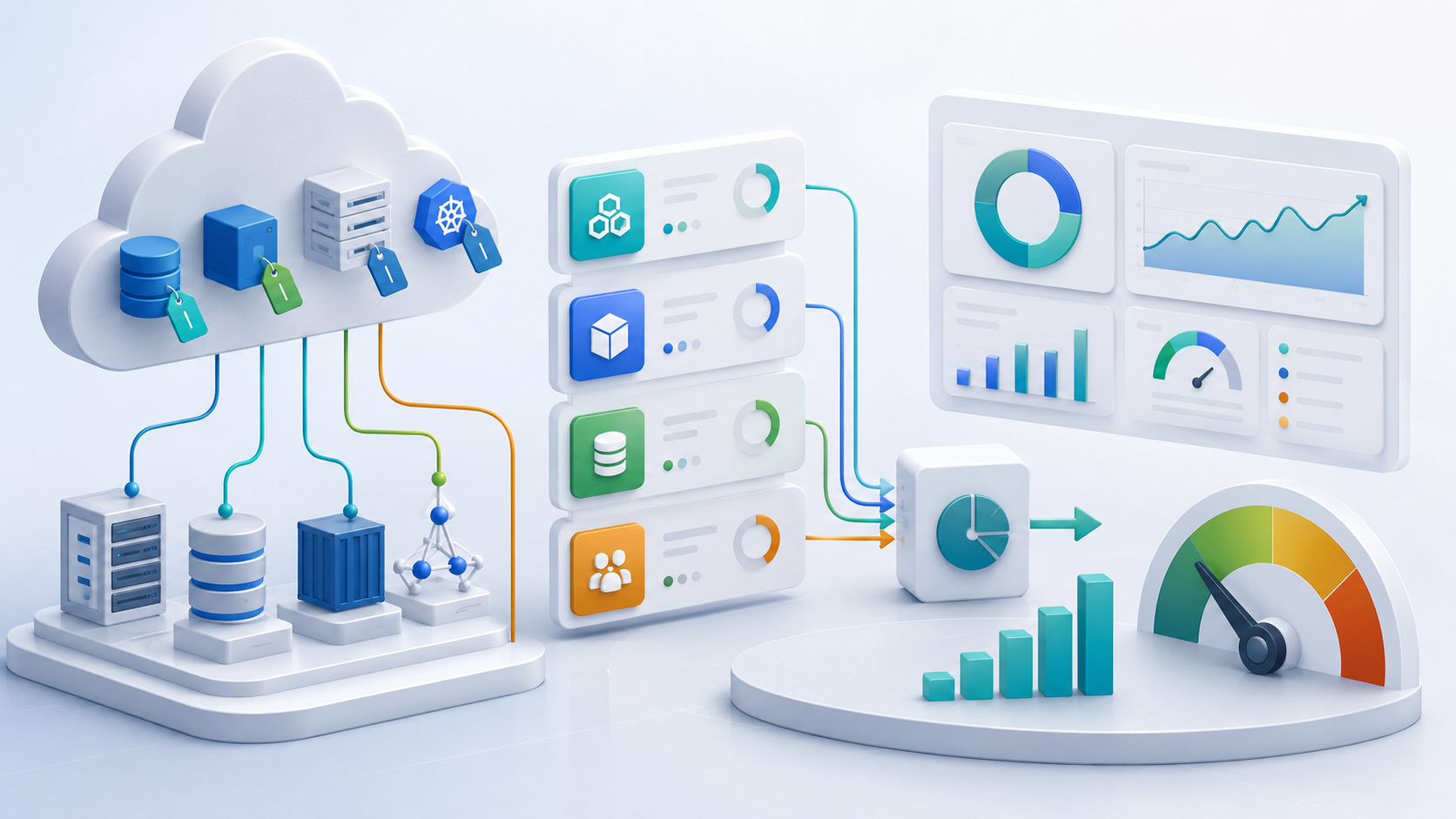
Once network connectivity and access have been set up, the team faces the next practical challenge: how to control the entire design in day-to-day operations. In a hybrid multicloud environment, it is not enough merely to connect the sites to one another. The company also needs to understand what is happening in each of them, how failures are detected, where security events can be investigated, and under which rules the resources are actually managed.
The problem is that environments like these easily begin to operate in isolation. Metrics may be collected in one domain, logs in another, and access policies and configurations in a third. As a result, the infrastructure is formally connected, but for the team it still remains fragmented: degradation is harder to detect in time, incidents take longer to investigate, and misconfigurations or access-control mistakes are more difficult to spot before they cause a problem.
This can be reduced to a few core control areas:
| What needs to stay under control | Why it matters |
| Monitoring and metrics | Without a shared view, it becomes harder to detect degradation, overload, and bottlenecks |
| Logs and security events | If data is scattered across environments, incident investigation takes longer |
| Policies and configurations | Different rules in different environments increase the risk of mistakes and inconsistent settings |
| Resource management | Without a common approach, the team spends more time on manual control and reconciliation |
That is why, in this kind of architecture, it is important to build a unified layer for monitoring, logging, and policy management early on. Otherwise, the infrastructure may look connected on paper, but in practice remain difficult to govern: outages take longer to investigate, access control becomes harder to verify, and configuration errors are more difficult to detect before they turn into real incidents.

Even when the idea of a hybrid multicloud design is justified for the business, projects like these usually fail not at the level of concept, but at the level of execution. In most cases, the trouble begins when a company connects several environments technically, but never builds a unified operating model around them.
The network is connected, but latency and routing were never modeled properly
Connectivity between sites does not automatically mean applications will behave predictably. If routing, latency, and traffic patterns between on-premises infrastructure and the clouds are not assessed in advance, the system can begin losing performance and stability soon after launch.
Access and roles follow different rules in each environment
One of the most common mistakes is allowing every environment to keep its own separate access model. The result is several inconsistent IAM structures, where permissions, roles, and areas of responsibility do not align properly with one another. That makes audits harder, increases the risk of mistakes, and reduces transparency of governance.
There is no unified layer for monitoring and logging
If metrics, logs, and security events remain scattered across different environments, the team does not see one complete picture, but only disconnected fragments. In that situation, failures are harder to detect, and incidents are slower to investigate and contain.
The architecture is designed “with maximum headroom” instead of for a specific task
Sometimes a company tries to build an overly complex setup from the start: multiple clouds, on-premises infrastructure, disaster recovery layers, and separate rules for everything all at once. Without a clear practical purpose, this quickly turns the architecture into a heavy system that is expensive to operate and difficult to evolve.
The team tries to standardize everything at once
Another common mistake is trying to unify all environments, processes, and policies from the very first stage. In practice, these projects usually work better when integration happens step by step: first network and access, then observability and security, and only after that deeper operational standardization. Otherwise, complexity grows faster than the actual business value.

After all the differences, limitations, and common mistakes, the main question becomes very practical: does the business actually need this kind of architecture at all? A hybrid multicloud model can look very convincing at the level of ideas, but in real operations it is justified only where it genuinely solves specific problems.
A quick reality check can be done using several common signals:
| Signal in the infrastructure | What it may indicate |
| There are local systems that cannot be moved out quickly | A full move into one cloud is unlikely to be a realistic scenario |
| Different platforms are needed for different tasks | One provider does not meet all business requirements equally well |
| Requirements for data, access, and placement vary | A more flexible model for workload distribution is needed |
| The IT environment is already split across several domains | It is better to build a manageable integration model than to support a fragmented landscape indefinitely |
| The value of flexibility and resilience is clearly higher than the operational cost | The complexity of this architecture may be justified |
If these signals are absent, and the infrastructure remains relatively simple without requiring complex workload distribution, then connecting on-premises servers to multiple clouds may turn out to be unnecessary. In that case, the business is more likely to gain additional complexity than real architectural value.
That is exactly why, at the end of a discussion like this, it is important to focus not on the abstract attractiveness of a hybrid or multicloud model, but on how well it matches the actual system landscape, data requirements, and the team’s operational capacity. And that, in turn, makes a good transition into the conclusion.

A hybrid multicloud architecture is not a universal standard, but a practical model for companies that already have distributed infrastructure, different data requirements, and a real need to combine on-premises systems with the capabilities of multiple clouds. In those conditions, it helps the business avoid breaking the existing landscape while expanding and modernizing it step by step.
But its value appears only when there is a clear practical purpose behind the architecture. If the business understands in advance what it actually wants to gain from this kind of integration — flexibility, resilience, control, or gradual modernization — then the model may be fully justified. If not, it can quickly turn into yet another source of complexity rather than an advantage.