
Anna D..Editor

Anna D..Editor
“It's fine to celebrate success, but it is more important to heed the lessons of failure.”
Bill Gates
Every evolution is a journey through a series of trials and lessons, where the capacity to adapt becomes not merely essential for survival but a gateway to new opportunities. Failures, in this context, are not final verdicts, but rather invaluable experiences that propel us forward with greater clarity and insight.
Today, we’ll apply this perspective to digital transformation or, as it's often termed, the “reimagining of business processes.”
First of all, let’s clarify what digital transformation entails and why it’s crucial for modern businesses.

The term "Digital Transformation" first emerged in the 2011 study titled "Digital Transformation: A Roadmap for Billion-Dollar Organizations", authored by G. Westerman, C. Calmejane, D. Bonnet, P. Ferraris, and A. McAfee from the MIT Center for Digital Business and Capgemini Consulting. Ironically, despite its foundational impact, at the time the term still lacked a singular, definitive meaning.
Over time, digital transformation evolved into a concept described by varied yet fundamentally aligned interpretations. Among them:
Global leaders recognize the scale and significance of digital transformation as well:
Clearly, the deliberate and comprehensive integration of digital technologies into core business processes is pivotal for organizational growth, though the path to success is seldom straightforward.

At first glance, digital transformation appears to be an assured ticket to the future, a straightforward pathway to progress. But what's going wrong if leading experts continue to write about the same mistakes?
According to Gartner (2025), merely 48% of digital initiatives, such as launching cloud platforms, implementing CRM systems, transitioning to online services, or automating business processes, truly achieve their business objectives. As you may have guessed, this means the rest fail. This is particularly true for cloud-related projects, where the complexities of integration, migration, and management amplify the risk of failure (as highlighted by CIO Dive based on the HFS/EY report).
There is, however, an elite group often termed the "digital vanguard" by researchers. These companies elevate their operations through immense effort from compact teams of senior executives who, alongside CIOs and other C-suite leaders, take collective responsibility and secure success in 71% of projects. Their distinctive feature is ongoing collaboration and substantial investment in cultivating digital skills internally. Yet, such companies remain a minority; Gartner notes only 16% of CIOs genuinely prioritize this approach.
Historically, the situation was even more dire. Back in distant 2018, Forbes reported that 70% of digital initiatives failed to meet their objectives, resulting in annual losses of hundreds of billions of dollars. The root causes remain consistent: inadequate collaboration, organizational silos—teams and departments operating in isolation without knowledge sharing or a holistic perspective, weak project management, and a basic lack of transparency.
Say, investments have been allocated, plans finalized, yet transformation efforts stall. Why does this happen? The reasons for these setbacks are numerous, and each demands thorough exploration. To understand this better, we'll examine insights drawn from open sources by international analytics firms McKinsey, BCG, and Accenture.
They highlight five primary causes driving digital transformation failures:
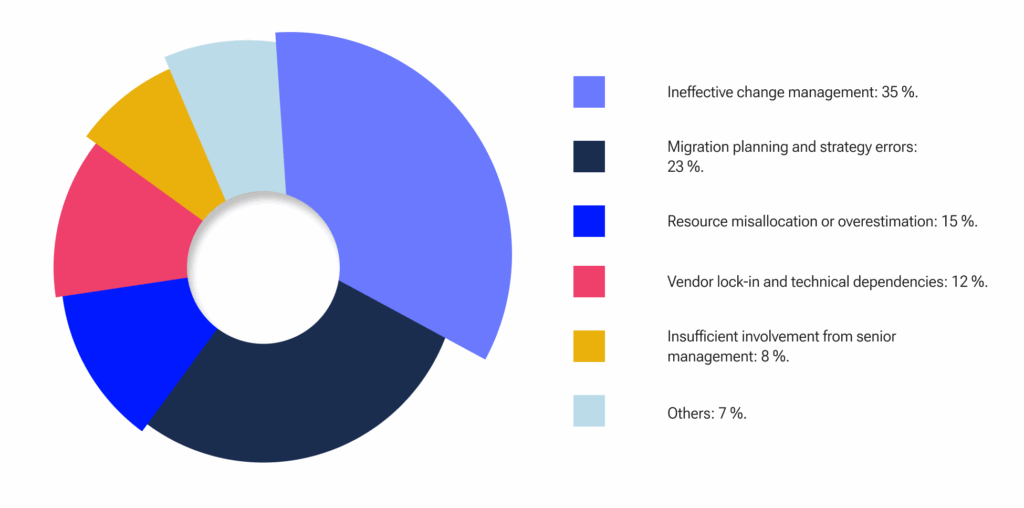
As we can see, nearly half of the issues revolve around managing change and planning missteps during migration. Next, we'll delve into the specifics of how digital transformations fail, identify common stumbling blocks for companies, and explore strategies to ensure your organization joins the fortunate 48% that succeed.
What exactly counts as a "failure"? Typically, it doesn't signify a total collapse of the project, but rather a gap between expectations and outcomes—such as unmet KPIs, budget overruns, missed deadlines, absence of ROI, or the failure of new solutions to become embedded within company operations.
Table 1. Criteria for Digital Transformation Failures (based on leading consulting firms):
| Criterion | McKinsey | BCG | Accenture | Industry Examples |
| Business objectives not achieved | + | + | + | Finance, Industry |
| Budget overruns | + | + | IT, Telecom, Retail | |
| Missed deadlines | + | + | Industry, Public Services | |
| No improvement in customer experience | + | + | Retail, Insurance | |
| Forced halt/project rollback | + | + | Manufacturing, Logistics | |
| Lack of ROI | + | + | All sectors | |
| Low employee and senior management engagement | + | + | Healthcare, Finance |
Note: “+” indicates the criterion identified as key in the company's research.
Digital transformation is usually discussed with optimism: new platforms, automation, and cloud services are all automatically considered steps forward. Yet, as reality often shows, outcomes can significantly diverge from expectations. Sometimes ambitious projects fail to deliver anticipated efficiencies, compelling businesses to revert to older, more established solutions. Such rare but instructive case studies illustrate the complexity and ambiguity inherent in digital change. Below, we'll explore two striking examples from the European and global markets.
In 2011, Lidl embarked on an ambitious project to replace its internal product management platform (Wawi) with an advanced SAP ERP system.
The transition took over seven years and consumed approximately 500 million euros. With market leaders, cutting-edge technologies, and an expert consulting team, every metric suggested success. Or did it?
In 2018, the project was canceled, and Lidl reverted to the trusted Wawi system.
What went wrong?
The primary issue emerged during the requirements alignment phase: SAP’s standard business processes were designed to handle inventory at retail prices, whereas Lidl traditionally managed inventory using purchase prices.
Instead of aligning their business processes with the software, the team opted to extensively customize the ERP system. Consequently, costs escalated, timelines slipped, and overall performance suffered.
Disappointment within the company was palpable. As Handelsblatt reported, “We are essentially starting from scratch.” Ultimately, Lidl's management conceded that strategic goals were unattainable without incurring further substantial expenses and terminated the project.
In the mid-2010s, GE invested billions into developing Predix, a massive cloud platform dedicated to the Industrial Internet of Things (IIoT). The company’s leadership set an ambitious goal: transforming GE from an industrial heavyweight into one of the world's largest IT companies.
Unfortunately for GE, by 2018, the strategy had changed dramatically.
GE’s digital division, Predix, was spun off into a separate entity, with a controlling interest in several services, including ServiceMax, sold to an external investor (Silver Lake). GE itself refocused on its traditional business sectors.
Why did the company take such a significant step backward?




The primary issue was the lack of market demand and support from industrial clients. Customers were not prepared to broadly adopt GE's software, favoring more agile and specialized solutions.
Additionally, Predix’s architecture proved too monolithic; the market required flexibility rather than an "everything cloud." Finally, under new leadership (CEO Lawrence Culp), GE prioritized cutting costs and moved away from expensive experiments.
GE publicly acknowledged that its attempt to "make software their core business" fell short of expectations and diverted crucial resources from its primary operations. In practice, becoming "a technology company" proved to be a tool, not a goal in itself.
Digital transformation failures don’t always manifest as spectacular disasters. More often, they are quite disappointed—businesses expend substantial resources but fail to see meaningful long-term returns. The root cause usually isn't the scale of investment but rather its quality. Companies that try to save money by cutting corners on expertise, support, or a well-thought-out long-term strategy typically end up incurring even greater expenses and losing valuable time. It's a bit like choosing to buy fast food rather than groceries: it seems cheaper in the short term, but longer-term health-related costs are higher.
An old saying captures this scenario perfectly: “I'm not rich enough to buy cheap things,” which in our context translates to “I'm not wealthy enough to afford low-quality solutions executed poorly.”

Given the statistics, it's reasonable to wonder: Is digital transformation even possible without substantial losses?
International research and recent analyses highlight several consistent behavioral patterns that really do mitigate risk. Let's examine five of these.
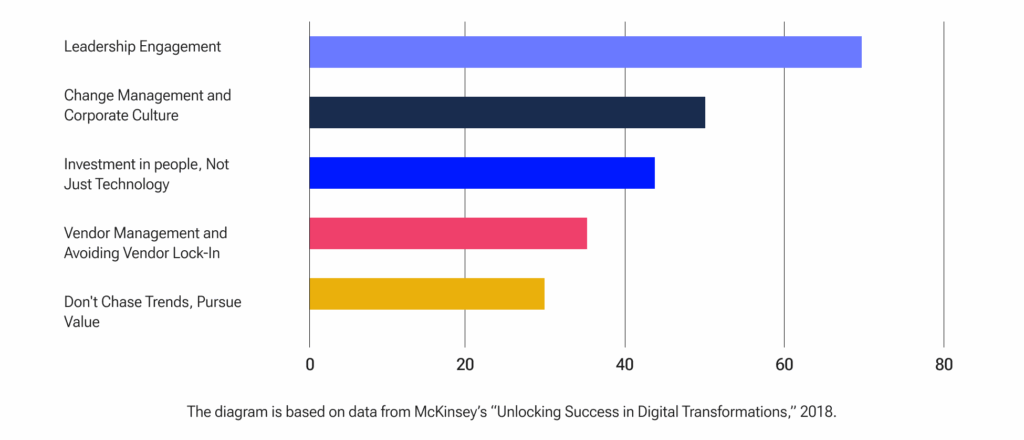
According to McKinsey’s "Unlocking Success in Digital Transformations" (2018), more than 70% of successful digital initiatives occur where senior management is genuinely engaged and actively driving the transformation, rather than treating it like a box-checking exercise. In contrast, this figure drops below 30% for companies that experience unsuccessful projects.
Further emphasizing this point, surveys conducted by BCG confirm that approximately 75% of executives personally oversee digital transformations at every project stage, recognizing digital technology as a critical revenue growth driver.
Merely proclaiming being “all about digital” is ineffective. Leaders must actively champion change—attending working sessions, addressing challenging questions, publicly acknowledging mistakes, and taking accountability for strategic decisions. Even a brief CEO video message or an open dialogue with teams can transform what might otherwise remain a formal, abstract project into a compelling part of the company’s narrative.
According to McKinsey, up to 50% of digital transformation failures stem from the "human factor": employees who don't understand the rationale behind the changes, fear losing their roles, or even actively sabotage new initiatives.
A common misstep is assuming everyone eagerly embraces "the new". Resistance often comes from mid-level management: line managers worry about losing influence, team members fear being "replaced by AI," or doubt the benefits of automation.
Therefore, it's crucial for leadership to clearly communicate why changes are necessary, precisely how these changes will impact individuals personally, what will happen to salaries, KPIs, and areas of responsibility. Embrace the principle of "small wins": celebrate even minor successes, document positive examples, and engage skeptics through concrete evidence and visible results, not merely through rhetoric.
Without investment in people, such as training, developing digital skills, and cultivating internal “change champions”, even the most advanced software won’t work. Consider Nestlé's example: adopting a flexible cloud strategy combined with extensive training accelerated product launches by 60% [Accenture, 2024].
Employees become cooperative rather than resistant when they recognize their value, experience genuine skill development, and feel supported rather than threatened by automation. It’s essential to encourage internal ambassadors, empower them with responsibility, and foster bottom-up initiatives.
Analysts from BCG suggest that relying excessively on a single vendor ("vendor lock-in") hampers flexibility and cost optimization. Market leaders proactively embed vendor diversification into their strategies. This includes contractual provisions that enable a "soft" migration to alternative solutions, such as transition plans, interim periods, and minimal penalties for changing providers. They also emphasize the importance of compatible and open standards (interoperable platforms, open APIs, and data formats) as well as clearly defined exit conditions from the outset.
A common pitfall is becoming overly reliant on a single vendor due to initial convenience. However, shifting platforms later becomes unexpectedly costly and complex. To mitigate this risk, it's crucial to establish migration conditions early on, explicitly detailed in contracts, service-level agreements (SLAs), and support for independent APIs.
According to McKinsey, chasing hype without a clear understanding of business value often leads to disappointment and wasted investment.
True effectiveness comes only from "purposeful" transformation. Rather than striving to outdo competitors with sheer quantity of services, focus on the value delivered: real-time savings, increased customer satisfaction, genuine cost reductions.
Below is a diagram highlighting key success factors for digital transformations. Note: the percentages don't add up to 100%; they reflect the frequency of successful outcomes among companies adopting these specific practices. Each figure illustrates how significantly the chances of success increase when employing particular drivers.

Most articles on digital transformation focus on "success stories" and best practices, but as mentioned earlier, reality is far more complex.
Even the most comprehensive plans cannot guarantee a smooth journey: digital projects inherently contain subtleties that are often overlooked. Below are some hidden pitfalls experienced by even seasoned companies—important considerations before starting any transformation.
Even if a project is abandoned, processes and team motivations inevitably shift. According to Forrester, 19% of large-scale digital initiatives never reach completion, leaving behind tangible impacts: frustration, fragmented data (altered structures, partially lost or dispersed information), and altered working habits.
Legislative changes (like GDPR in the EU or HIPAA in the US) can abruptly slow or halt even successful initiatives, forcing companies to redesign system architectures, enhance data protection measures, or even temporarily pause their projects.
According to the recent European Commission report, “State of the Digital Decade 2025”, despite significant strides in digitalization, numerous projects face hurdles from complex regulatory frameworks, limited digital skills, and a scarcity of ICT specialists, particularly in AI and cybersecurity.
The EU remains heavily reliant on overseas cloud service providers and infrastructure, leaving businesses vulnerable to regulatory shifts and external threats.
Moreover, the digital technology market remains fragmented and heavily influenced by intricate national and pan-European standards, complicating the adoption of new solutions and innovation.
Cloud Transformation: Two Sides of the Same Coin
The cloud offers substantial opportunities for growth and flexibility: on-demand scalability, rapid deployment of new services, and reduced infrastructure costs. However, these advantages come with distinct risks: complex migration processes, security concerns, and potential dependency on a single provider.

Digital transformation is a pivotal moment for businesses—one where they either experience significant growth or remain static, like timeless artifacts.
It's much like the process of growing up: first, you celebrate earning your initial tenner, then you get into it, earn your first hundreds, then thousands. Eventually, you're faced with a crucial decision: spend it all in one, or invest into something to help you reach a new level?
The core idea is straightforward: any business aiming to thrive and build a foundation for tomorrow must learn to think strategically and long-term. Once you decide to move forward, you face the same fundamental choices as in life: invest in momentary pleasures or create lasting foundations.
A delightful analogy comes from the famous Stanford marshmallow experiment. The question is simple yet profound—do you choose immediate gratification with one marshmallow now or delay reward for two later?
Practical Steps to Ensure You Don’t Get Left Behind:
Particular attention should be given to cloud transformation, as migrating to the cloud acts as a catalyst for many of the changes discussed earlier. Cloud technologies enable businesses to rapidly scale, innovate cost-effectively, and build adaptable infrastructure tailored to their unique needs.
However, cloud transformation isn't merely about changing servers; it's about fundamentally rethinking processes, roles, and approaches to security and data management. Companies that incorporate cloud strategies into their long-term planning secure a competitive advantage and resilience for years to come.
Businesses that thrive and endure are those unafraid to adjust their approach, acknowledge mistakes, and push forward, even amid unexpected challenges.
P.S.: Personally, I believe everything we label as "transformation" really begins and ends with people—their willingness to learn and grow together.

The European cloud market has become a battleground between two worlds. On one side stand American hyperscalers, backed by multibillion-dollar investments and global scale. On the other hand, local providers prioritize trust, data sovereignty, and control over infrastructure.

2025 is reshaping the game: cloud has become the core of corporate strategy, influencing financial efficiency, independence, and resilience. This article explores how to manage costs through FinOps, strengthen trust with sovereign cloud and ESG practices, and leverage Generative AI and Serverless 2.0 to accelerate innovation.

Digital transformation can no longer be reduced to simply adopting new technologies. Today, it calls upon IT leaders to cultivate intellectual agility, rethink strategic fundamentals, and rebuild teams from the ground up.